


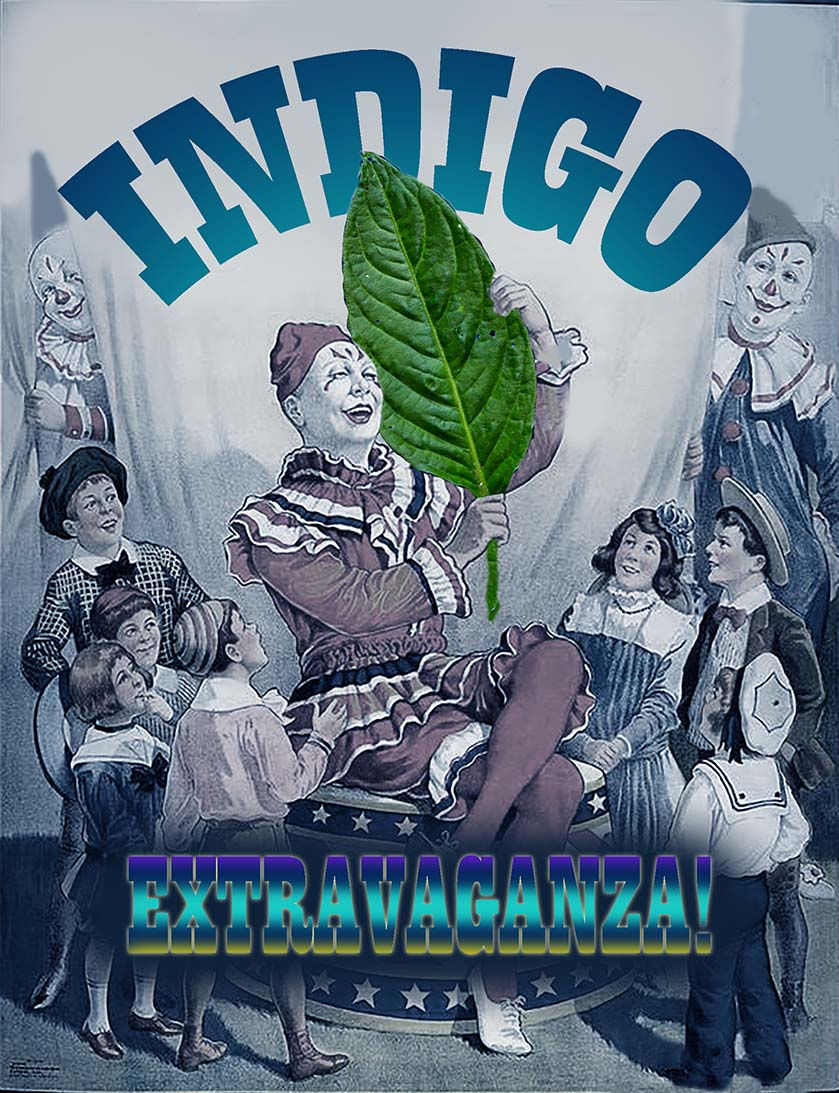

This twelve-session program covers every facet of traditional Japanese indigo dyeing along with innovative variations straight out of John’s brain – the goal is to leave you with a thorough understanding of how Persicaria tinctoria works and to be able to venture off on your own with confidence. We'll be working on silk, cotton, hemp, wood, leather, and tiles, paper.
The series is broken into four segments of three sessions each. Every session is offered as an intensive two-hour Zoom presentation with roughly half the time spent on understanding the process involved and half focusing on projects designed to bring the concept to life.
You may select topics ala carte based on your specific needs, or purchase the entire series at a substantial discount.
$985 for the entire program
$325 per three-session segment
or pick and choose as you like, $125/individual session
To order Segment ONE, A, B or C as a stand alone choice, $325@, click on one of the following:
One-A
One-B
One-C
Each session is recorded, available for you to download and keep for future reference. You're also welcome to follow up by emailing your questions to John for a thorough response.
Full Course.- Indigo Extravaganza
See what's inside:
Segment ONE – developing a clear foundation of knowledge from which to build
1 – A Just What is Japanese Indigo?
A thorough exploration of how indigo functions along with how to achieve the broadest range of colors possible through various extraction techniques and pH manipulation – including yellow, green, cinnabar, and purple.
1 – B Fresh Leaf Direct Application
Applying the fresh leaves directly to the fiber may seem simple enough but in reality, it can be a tricky procedure. Over the past fifty years, I’ve developed a great many tricks and tips to allow you the greatest artistic expression with this simplest of materials.
1 – C Fresh Leaf pH Neutral Cold Baths
One of the joys of working with Persicaria is the ability to achieve so many effects with so little. The basic fresh-leaf bath is easy to prepare, and, in this segment, we’ll be covering a myriad of approaches to take advantage of the quirky nature in which the dye stains the fiber.Segment TWO – extracting pigments and developing reduction vats
2 – A Reduction Vats Starting with Fresh Leaves
Just what is a reduction vat? Starting with the most basic approaches to extracting indigo pigment from fresh and dried leaves, we’ll explore the differences between high-pH reduction vats and pH-neutral dye baths – along with the hows and whys of their basic operations.
2 – B Reduction Vats Starting with Pigments
Pigments come in many forms. We’ll discuss the best sources for natural indigo pigment and which states are the easiest to employ. We’ll use the pigments we produced in the earlier session, 2–A, as well as commercially available pigments, to develop a variety of reduction vats while exploring the pros and cons of each.
2 – C Reduction Vats Starting with Mystery Sources
In this session we’ll delve into accessing the inner child of several mystery indigo sources – including John’s Cow Pie Indigo vat (also known as Cry Baby Indigo). In essence, these will all be vats made from left over bits of this and that, including what may be considered the orphan children of the deep recesses of your studio refrigerator–sources for which we may not easily determine the volume of indigotin present in calculating the other ingredients crucial to a successful reduction vat.Segment THREE – working with resists to enhance designs
3 – A Rice Paste Resist and Indigo.
Rice paste is my resist of choice. I use it in almost all my work. It’s water soluble and totally non-polluting, and ideally suited to using with indigo. In this section, I’ll share with you a myriad of ways to make use of its properties in your artistic endeavors.
3 – B Clamp Resist and Indigo
Clamp resist is one of the several classic techniques used in association with indigo. It’s low-tech and yet allows for complex and nuanced designs.
3 – C Tsujigahana – Combining Shibori Techniques with Stencils and Direct Painting
Tsujigahana combines the soft edges of shibori with the refreshing clarity of sharply painted details and softened blushes of color applied through stencils. Made famous in the West by the artist Itchiku Kubota, John will share with you all of the carefully guarded secrets of this ancient process.Segment FOUR – combining skills to create dynamic works of art
4 – A Indigo on Paper and Non-Fiber Materials
I’m often asked about using indigo to dye paper. In this session, I’ll be covering vat dyeing on paper as well as printing on leather. We'll also be dyeing on ceramic tiles and wood, just to prove how far we can go!
4 – B Landscapes and Direct Painting with Indigo
A great many folks limit their vision to dyeing solid colors, and perhaps stretch a bit into patterns and textures. But have you ever considered it as an expressive art medium? I’ll be sharing several unique methods I’ve developed for creating painterly artwork. I’ll be focusing on landscapes with the understanding that the processes covered may be applied to whatever your imagination conjures up.
4 – C Designing Garments with Fresh Leaf and Reduced Indigo
My career has been based on my passion for textiles and the garments created from them. For the grande finale in this series, I’ll be walking you through the steps I employ to create my one-of-a-kind fashions, making use of all the forms of indigo we’ve covered over the past few weeks, and at the same time, presenting how to incorporate modest amounts of other natural dyes for added interest.
